
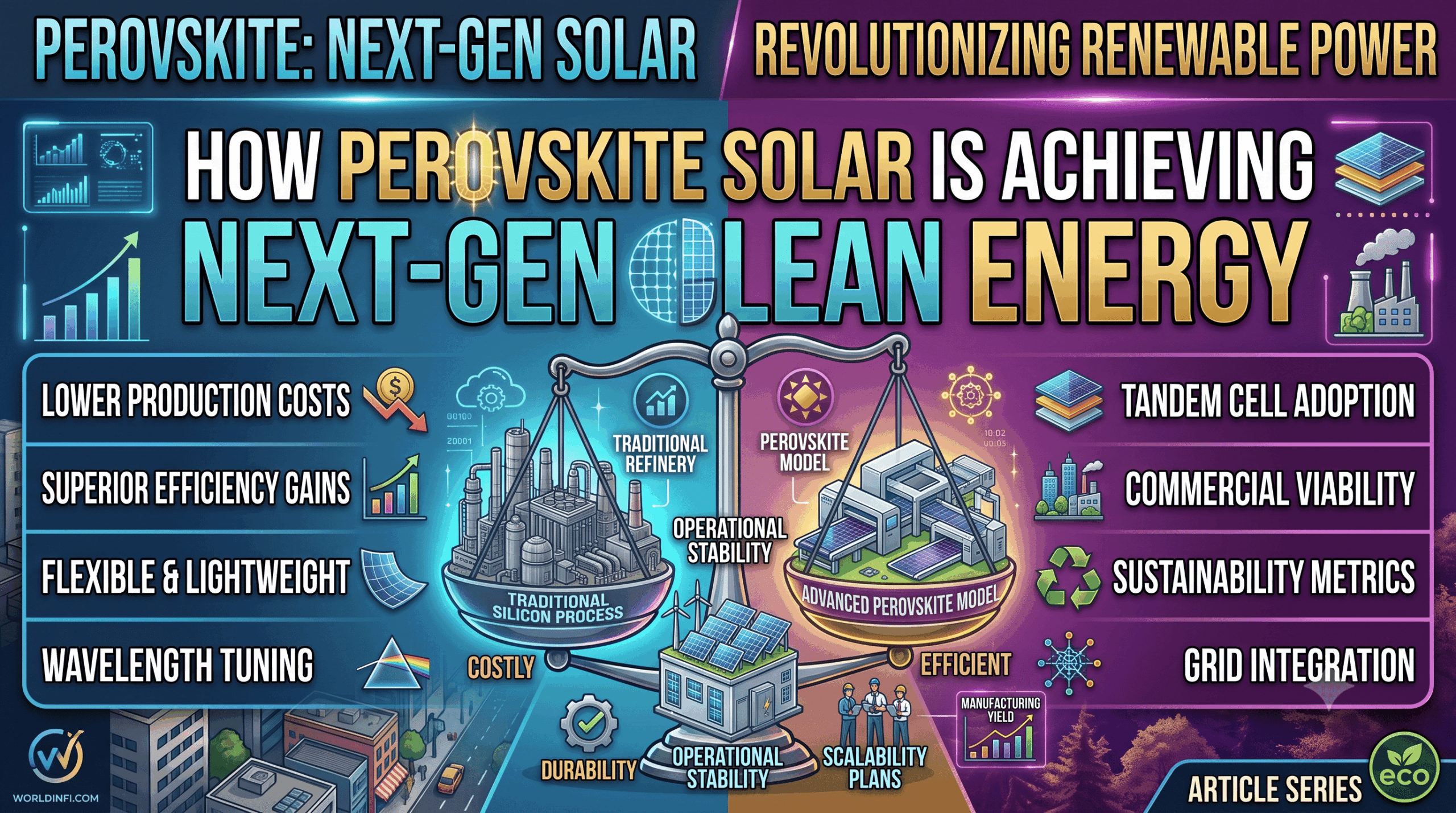
Next-Gen Clean Energy: How Perovskite Solar Cells Are Revolutionizing Renewable Power
The global shift toward renewable energy has placed solar power at the forefront of clean tech solutions. For decades, traditional silicon-based solar panels have dominated rooftops and solar farms across the globe. While effective, silicon technology is rapidly approaching its theoretical limits in energy efficiency and remains costly to manufacture. Enter perovskite solar cells, a technological breakthrough that promises to dramatically increase solar efficiency while drastically reducing production costs.
What Are Perovskite Solar Cells
Perovskite refers not to a specific material, but to a unique crystalline structure named after Russian mineralogist L. A. Perovski. Materials sharing this crystal lattice possess extraordinary optoelectronic properties, meaning they excel at absorbing sunlight and converting it into electrical energy.
Unlike rigid, heavy silicon wafers, perovskite compounds can be formulated into liquid inks. This enables them to be printed or sprayed onto flexible substrates like plastic or glass using low-cost manufacturing processes similar to commercial printing presses.
The Efficiency Breakthrough: Tandem Solar Cells
The primary advantage of perovskites lies in their efficiency gains, especially when paired with existing silicon technology; a configuration known as tandem solar cells.
-
Single-Junction Silicon: Traditional commercial panels typically convert 18% to 22% of sunlight into electricity, with a hard theoretical upper limit around 29%.
-
Perovskite-Silicon Tandems: By layering perovskite on top of standard silicon, the cell captures different spectrums of light. Perovskite absorbs high-energy blue and green wavelengths, while silicon processes the longer infrared light. In laboratory settings, tandem cells have already surpassed 33% efficiency—a record-breaking figure achieved in record time.
Key Advantages Over Silicon
-
Lower Production Costs: Manufacturing perovskites requires lower temperatures and fewer energy-intensive processes than refining silicon, significantly cutting capital expenditures.
-
Flexibility and Lightweight Applications: Because they can be printed on thin surfaces, perovskites open doors for wearable solar electronics, building-integrated photovoltaics (BIPV), and curved vehicle roofs.
-
Wavelength Tunability: Scientists can adjust the chemical formula of perovskites to target specific light spectra, optimizing performance across varied geographical climates.
Current Challenges: Stability and Commercial Viability
Despite their immense potential, perovskite solar cells face engineering hurdles before full-scale commercialization:
-
Operational Stability: Perovskites tend to degrade faster than silicon when exposed to moisture, oxygen, and sustained high temperatures. Researchers are actively developing protective encapsulation layers to extend cell lifespans.
-
Scalability: Transitioning from small laboratory prototypes to large commercial modules without losing power conversion efficiency remains an active focus for clean-tech engineers.
The Future of Solar Energy
Commercial deployment of perovskite-silicon tandem panels is expected to scale globally over the next few years. As clean energy investors and tech startups funnel resources into overcoming stability bottlenecks, perovskites stand poised to make solar power more accessible, affordable, and efficient than ever before.

Team at World Infi